
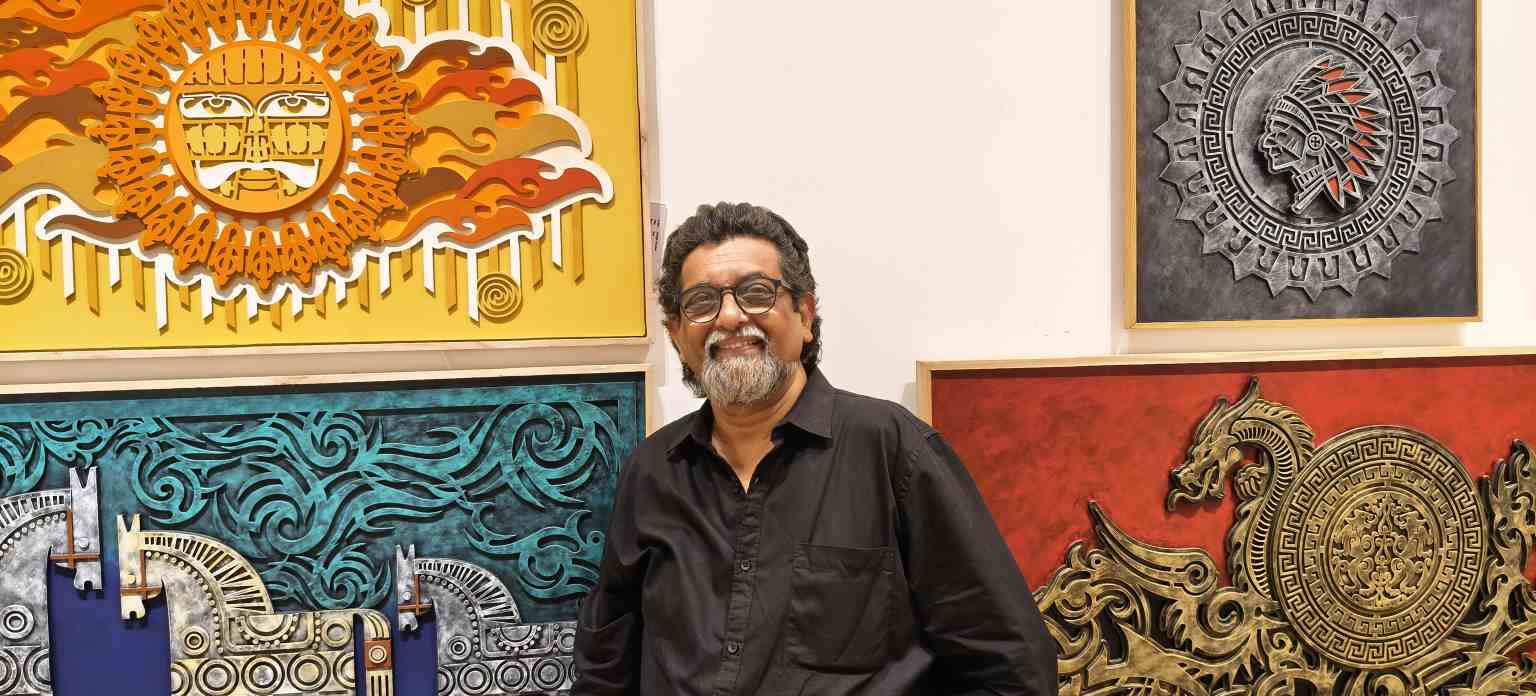

At The Gold Dynasty group exhibition at Jehangir Art Gallery, artist Abhijit Chaubal presents a compelling body of sculptural wall works that occupy an intriguing space between fine art, industrial technology, and handcrafted surface experimentation. Trained at the prestigious Sir J. J. School of Art and seasoned by over four decades in the advertising industry, Chaubal brings to his practice a rare synthesis of graphic precision, visual communication, and tactile storytelling.
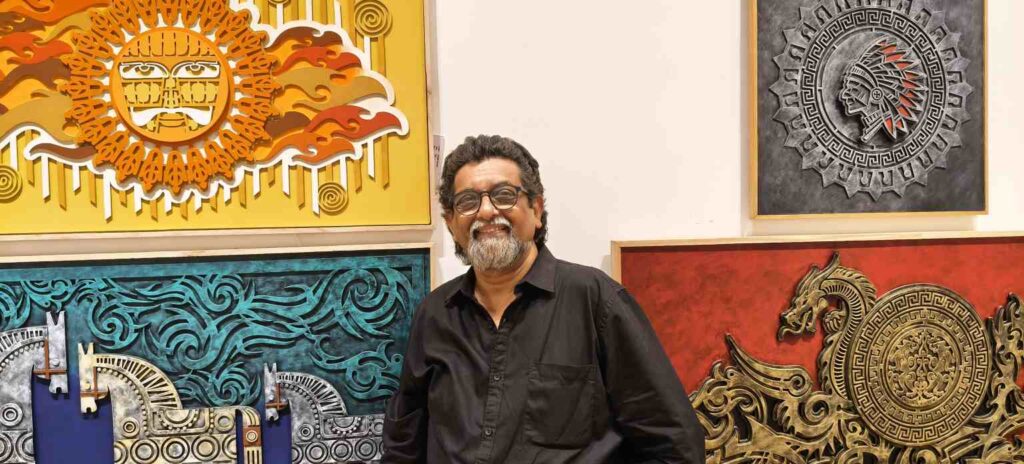
What distinguishes Mr. Chaubal’s work is not merely the use of technology, but the way he humanises it. His relief murals—crafted through laser-cut MDF wood, layered assembly, primer coatings, and hand-finished acrylic patinas—transform an industrial process into something deeply emotive and culturally resonant. The works possess the structural sharpness of digital design, yet retain the warmth and imperfections of artisanal craftsmanship.
His artistic journey into this medium began unexpectedly during the 2020 lockdown. A visit to a media technology expo introduced him to laser-cutting machinery typically associated with metal fabrication and commercial production. Where others may have seen a manufacturing tool, Chaubal perceived sculptural possibility. Drawing from his long-standing expertise in digital artwork creation, he began experimenting with small-format laser-cut compositions. What followed was not simply a technical exercise, but the birth of an entirely new visual language. The murals exhibited at Jehangir Art Gallery reveal an artist fascinated by civilisation, mythology, sacred symbolism, and archetypal memory. Yet these references are never literal reproductions. Instead, Chaubal reconstructs them through a distinctly contemporary lens.
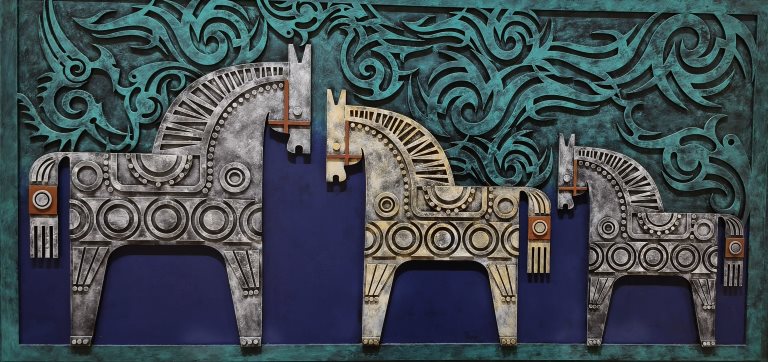
One of the most striking works features a procession of stylised horses rendered through concentric mechanical motifs and tribal ornamentation. The composition evokes echoes of ancient cave drawings, Central Asian equestrian iconography, and modernist geometric abstraction simultaneously. The oxidised turquoise backdrop creates a weathered archaeological ambience, while the layered relief technique gives the piece remarkable dimensional depth. The horses appear less like animals and more like cultural carriers moving across time itself.
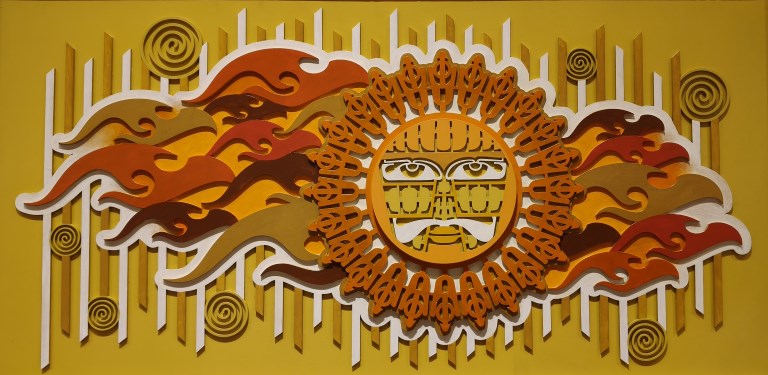
Another commanding mural radiates solar energy through a stylised sun deity surrounded by flowing flame-like forms. Here, Chaubal’s advertising sensibility becomes evident in the clarity of composition and chromatic impact. The fiery oranges, yellows, and ochres generate a kinetic rhythm, while the layered cut-outs create shadows that shift with viewing angles. The work balances graphic boldness with spiritual symbolism, recalling indigenous ritual aesthetics while remaining unmistakably contemporary.
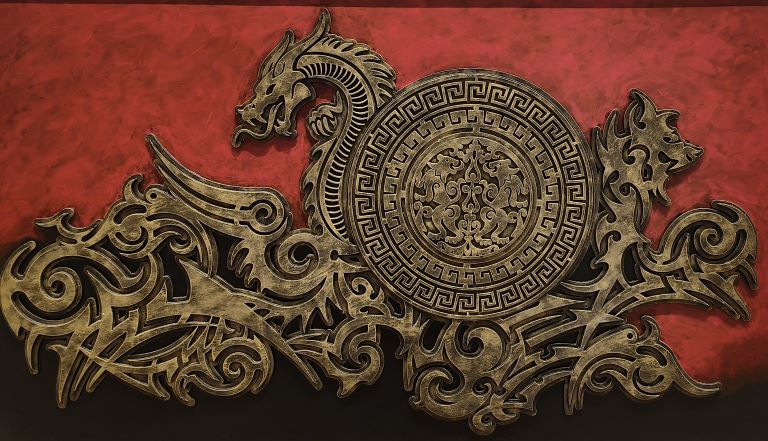
Equally compelling is his dragon-inspired relief work, where swirling ornamental forms merge with a central medallion motif. The piece demonstrates Chaubal’s sophisticated understanding of negative space and visual movement. The bronze-like finishing lends the mural the appearance of excavated antiquity, almost resembling a relic recovered from a forgotten empire. Despite its decorative richness, the work never collapses into excess; its composition remains disciplined and architectonic.
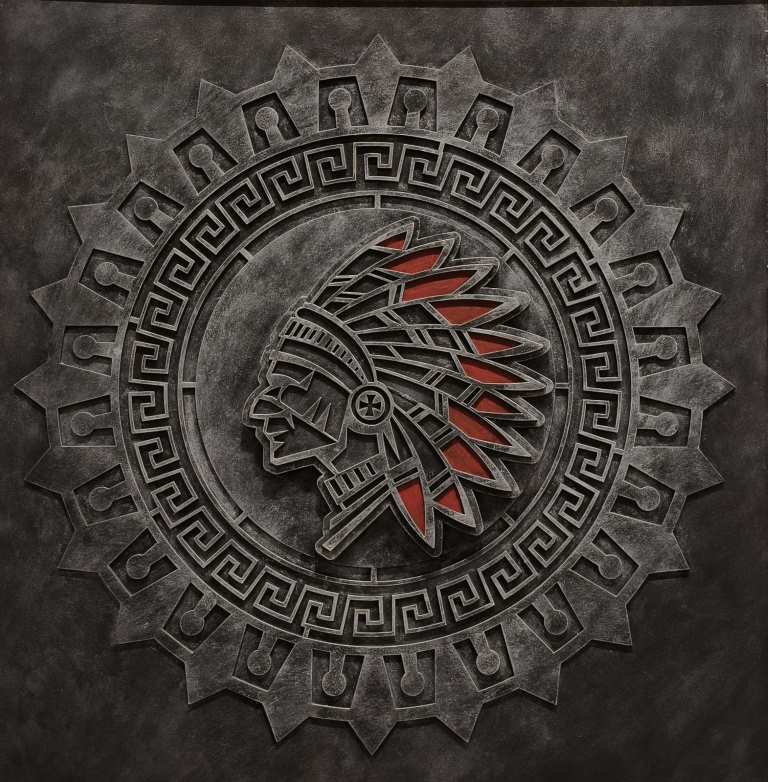
Among the exhibition’s most emotionally resonant pieces is a monumental circular composition featuring the profile of a Native American chief framed within an elaborate geometric border. The mural carries a quiet dignity and solemnity, amplified through its stone-like textures and restrained monochromatic palette punctuated with muted crimson accents. Rather than appropriating imagery superficially, Chaubal approaches the subject with reverence, using sculptural layering to evoke themes of identity, resilience, and ancestral continuity.
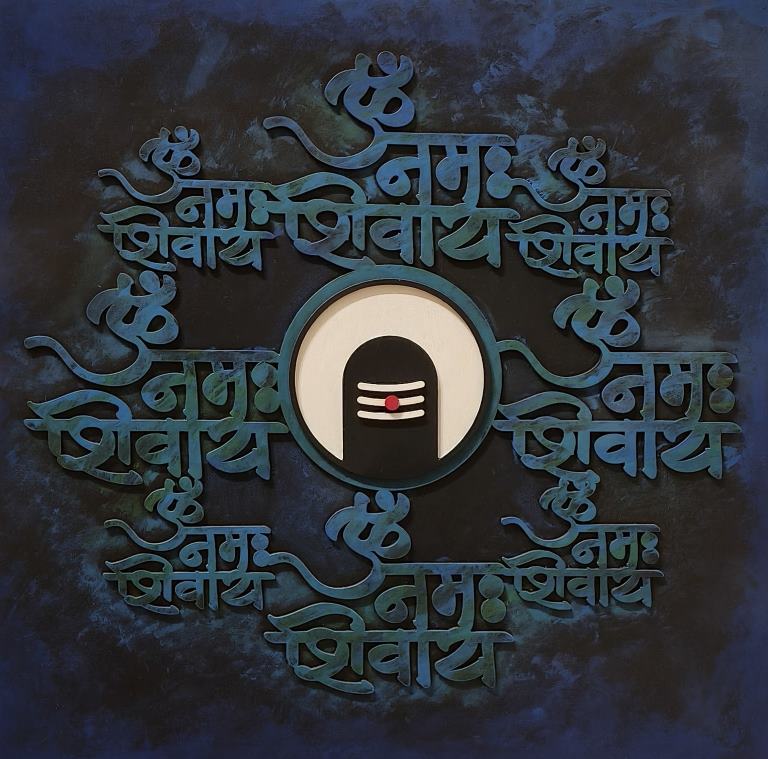
His spiritually inclined compositions are equally notable. A mural centred around the sacred Shiva lingam and surrounded by rhythmic repetitions of “Om Namah Shivaya” transforms typography into sculptural meditation. The text itself becomes architecture. The layered Devanagari script creates both visual rhythm and devotional atmosphere, demonstrating Chaubal’s ability to merge graphic design principles with sacred aesthetics.
What ultimately makes Abhijit Chaubal’s practice significant is his refusal to position technology and tradition as opposing forces. His works argue instead for coexistence. Laser cutting, in his hands, is not a cold mechanical intervention but a contemporary chisel—one capable of carving mythology, memory, and emotion into layered form.
There is also a democratic accessibility to his art. Coming from an advertising background, Chaubal understands the power of immediate visual engagement. His murals communicate instantly, yet reward prolonged observation through texture, layering, and symbolic complexity. They possess both decorative grandeur and conceptual depth, making them equally suited to galleries, architectural spaces, and contemporary collectors seeking culturally rooted modernism. Following the lockdown, Chaubal’s debut showcase at Raja Ravi Varma Art Gallery in Pune in 2022 marked a turning point in his artistic trajectory. The strong collector response—where nearly half the exhibited works were acquired—confirmed the growing resonance of his experimental practice. Subsequent exhibitions across Maharashtra and Goa further established his presence within the contemporary art circuit, earning appreciation from art patrons and public figures alike.
At The Gold Dynasty, Chaubal emerges not merely as an artist experimenting with material innovation, but as a visual storyteller forging a new sculptural vocabulary for contemporary Indian wall art. His works stand at the intersection of machine precision and human imagination—where mythology is laser-cut, memory is layered, and tradition is reborn through technology.