
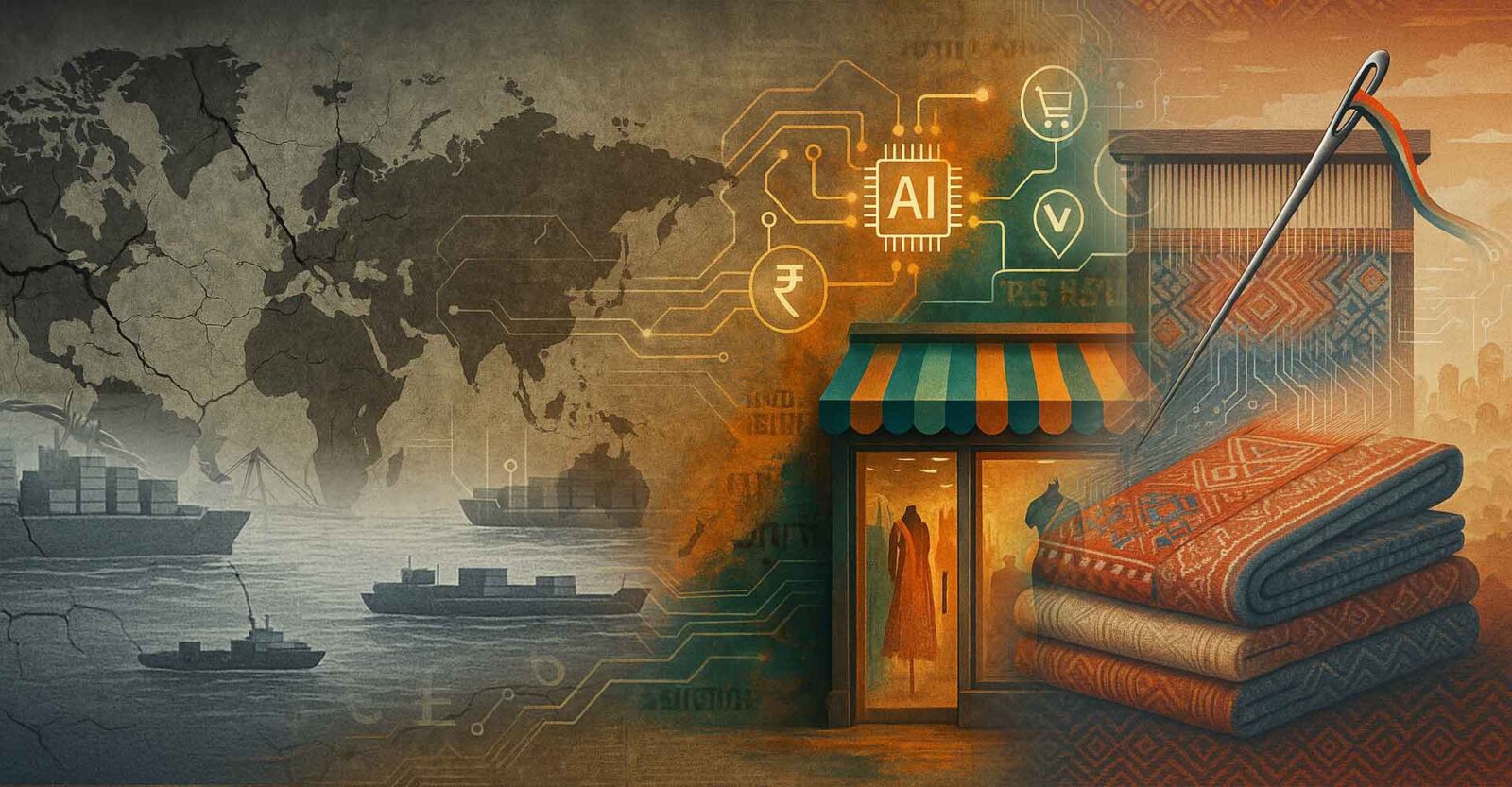

As the global landscape reels from mounting geopolitical tensions, economic fragmentation, and logistical breakdowns, the fashion and retail industry in India finds itself at a pivotal crossroads. The 2025-26 fashion calendar is no longer tethered solely to aesthetics or seasonal shifts. Instead, it reflects a strategic, multi-layered response to unprecedented global flux – one that emphasizes adaptability, self-reliance, and socio-political awareness.
The era of predictable globalization has decisively ended. What remains is a challenging but opportunity-laden terrain where resilience, digital innovation, and localism are redefining the Indian fashion narrative.
A growing storm of geopolitical tensions, trade disruptions, and economic realignments is redefining this equation – especially for India. Let take a closer look at these triggering factors:
Geo-Political Disruptions Are Reshaping Supply Chains
Since early 2025, Houthi-led disruptions in the Red Sea, which is one of the world’s most critical maritime routes, have led to prolonged shipment delays and a 30 – 60 % surge in freight costs to Europe. Indian textile hubs like Tirupur, Surat, and Ludhiana have been forced to reroute shipments via the Cape of Good Hope, causing cascading impacts on spring-summer 2025 deliveries. Major international brands including Zara, Levi’s, and H&M have renegotiated delivery timelines and contracts with Indian vendors, squeezing margins and testing logistical agility.
President Trump’s announcement of “reciprocal tariffs”, a sweeping import policy with a baseline 10% and up to 26% on Indian apparel – has jolted India’s largest apparel export market. Although implementation is paused until August 1, 2025, the anticipated impact threatens nearly ₹7 billion (~USD 85 million) in annual exports. Indian exporters, in response, compressed Q1 production schedules to beat deadlines, leading to temporary supply gluts and capacity misalignments.
On July 15, 2025, NATO Secretary-General Mark Rutte warned India (along with other BRICS nations) of potential secondary sanctions for continued trade with Russia. Given that India sources around 20% of its polyester feedstock from Russia, this has introduced a layer of input-cost volatility for synthetic fabric manufacturers. Immediate responses have included government-initiated diversification of crude oil imports from over 40 nations.
Economic Realignment and Strategic Shifts
India is benefiting from the global pivot away from China (i.e. The Rise of China + One strategy), a result of prolonged US-China tariff tensions and strategic re-alignments. The China Plus One Strategy has emerged as a strategic response, diversifying sourcing and production to alternative manufacturing hubs while maintaining a presence in China. This has made the China Plus One Strategy a compelling imperative for global manufacturers. With Vietnam, Bangladesh, and Mexico gaining traction, India’s opportunity lies in scaling quickly and compliantly. Partnerships like “Shein – Reliance’s India” has made export initiative signal renewed global confidence in India’s manufacturing infrastructure. However, to fully capitalize, India must focus on quality, compliance, and fast fashion delivery models.
Gone are the days of razor-thin inventories. Indian fashion majors—Arvind Fashions, Aditya Birla Fashion & Retail, and Reliance Retail—are moving to buffer-based “just-in-case” models. Investments in inland textile parks, especially in Tamil Nadu and Karnataka, have grown by 15% in 2025 alone. Concurrently, air-cargo facilities are being enhanced to support high-value, time-sensitive exports.
Technology, Compliance, and the Digital Pivot
AI-powered forecasting tools and blockchain-enabled traceability systems have emerged as indispensable tools. These technologies are helping brands streamline inventory, minimize waste, and comply with global norms such as the EU’s Digital Product Passport regulation.
India’s 2023 Digital Personal Data Protection Act (DPDPA), enforced more rigorously in 2025, mandates transparent, secure handling of consumer data. Personalization engines used by fashion-tech startups are undergoing major compliance audits, impacting UX and digital retail practices.
With sustainability and traceability becoming prerequisites in European and American markets, Indian exporters are embedding digital IDs, QR-enabled product passports, and end-to-end supply chain visibility to meet buyer expectations. This repositions India not as a low-cost alternative, but as a high-integrity, quality-forward production hub.
Conscious Consumption and Hyperlocalism
Consumer sentiment in 2025 is increasingly shaped by environmental concern, ethical purchasing, and socio-political consciousness. Handloom and indigenous textile-based apparel sales have grown 26% YoY. Homegrown brands like Okhai, Bunaai, and FabIndia are at the forefront of this ‘hyperlocal renaissance’.
Slow fashion, circular design, and service-based fashion—rental, resale, and repair—are gaining traction. Startups such as Date The Ramp and Green Stitch are pioneering this shift, fostering a culture of durability and value-based fashion choices.
Policy and Institutional Catalysts
The Indian government’s aggressive production-linked incentives (PLI), ₹600 crore subsidies for yarn and machinery, and duty waivers are helping domestic players scale up efficiently. A recent 11% YoY rise in garment exports from April to November 2024–25 reflects early success.
Simultaneously, India’s participation in global trade dialogues—despite BRICS-related tensions—signals a nuanced balancing act: asserting sovereignty while remaining investment-friendly and globally relevant.
The challenges remain formidable, but the outlook is quietly confident. The new Indian fashion narrative is not just shaped by trends, but it is sculpted by strategy, sustainability, and sovereignty.